

Assessed Value vs. Market Value: What Every Homebuyer Should Know

The largest portion of the United States population is Millennials, at over 72 million people strong, but only 17% of millennials own a home.
However, there are a lot of millennials that want to buy a home and, in many cases, that creates a bidding war that increases values. Especially in Southeastern Michigan, many homebuyers have struggled to buy a home due to the drastic speed in which most are sold.
Learning the difference between the Assessed Value and the Market Value is very important for homebuyers, but it is also useful information for existing homeowners to be aware of.
Preparing to Buy or Sell a Home
During the home buying process, there will be an appraisal done on the property. This appraisal is usually required by the mortgage provider, but those buying in cash would be wise to pay for their own appraisal.
This is the process of a professional reviewing the home details and determining a fair estimate of the home’s value. This is important because it informs all parties of the estimated value to ensure a fair purchase price. “Assessments” and “Appraisals” follow a very similar process, but the difference is that “Assessments” usually only refer to the city’s required valuation, and the “Appraisal” is more focused on the value of the sale of a home.
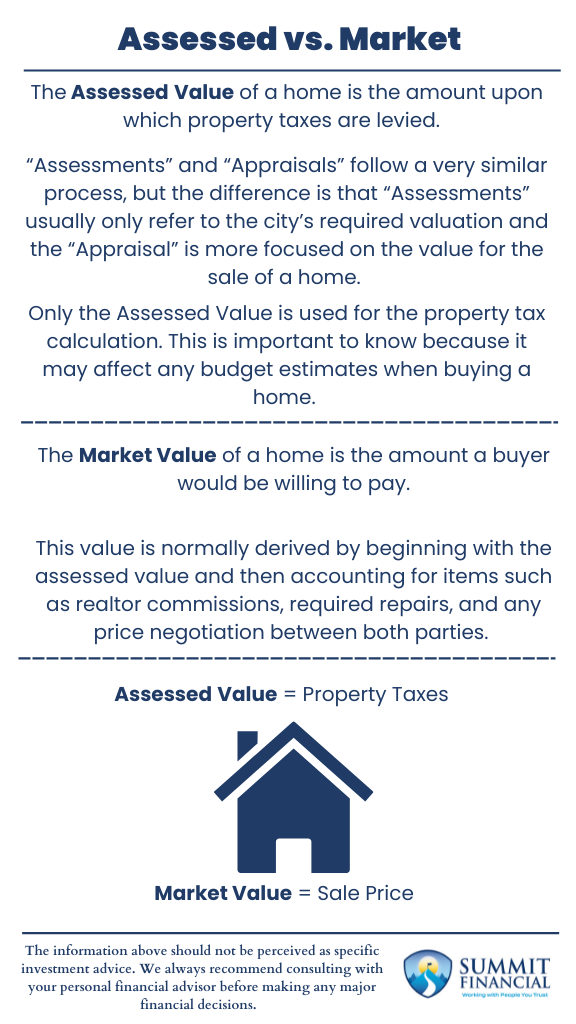
!Infographic comparing assessed value and market value: assessed value for tax calculations and market value as the buyer's purchase price, including key factors like appraisals and property taxes
How Market Value is Calculated
The Market Value is the actual value for which the home is purchased for. This value is typically derived by beginning with the assessed value and then accounting for items such as realtor commissions, required repairs, and any price negotiation between both parties.
A seller could list their property at $100,000 based on the appraiser’s opinion, but that does not mean someone is willing to pay that amount. The amount the property can actually be sold for is referred to as the Market Value.
How Tax Assessed Value is Calculated
So, why is it important to know the difference? This primarily comes down to the annual property taxes.
Only the Assessed Value is used for the property tax calculation. This is important to know because it may affect any budget estimates when buying a home. As the Assessed Value increases, so will the property taxes that are due, regardless if the actual Market Value has increased or not.
Some cities or counties will require an assessment periodically to ensure that property taxes keep up with any increase in the assessed property value. These “Assessments” can be contested if the homeowner believes the value is not accurate.
Things such as remodels, property enhancements, and recent home sales can all be factors that may influence the Assessed Value, and these may not be fully available to the professional valuing the property.
Assessed Value vs. Market Value – Summarized
- The Assessed Value of a home is the amount upon which property taxes are levied.
- The Market Value of a home is the amount a buyer would be willing to pay.
Speak With a Trusted Advisor
If you have any questions about your investment portfolio, retirement planning, tax strategies, our 401(k) recommendation service, or other general questions, please give our office a call at (586) 226-2100. Please feel free to forward this commentary to a friend, family member, or co-worker. If you have had any changes to your income, job, family, health insurance, risk tolerance, or your overall financial situation, please give us a call so we can discuss it.
We hope you learned something today. If you have any feedback or suggestions, we would love to hear them.
Best Regards,
Zachary A. Bachner, CFP®
with contributions from Robert Wink, Kenneth Wink, and James Wink
Sources:
Zach Bachner
After graduating from Central Michigan University in 2017 with specialized degrees in Finance and Personal Financial Planning, Zachary “Zach” Bachner set himself apart by earning the CFP® designation and passing the Series 7, 63, 65 licensing exams early in his career. Zach gained valuable real-world experience with the team at Summit Financial Consulting, who treated him like family. Their guidance helped him refine his skills in practical, client-centered planning, where putting their needs first was non-negotiable. This focus on trust-building not only allowed him to cultivate strong relationships, but also allowed him to continue doing what he loves most: solving client problems through efficient financial planning strategies. Leveraging his experience, Zach now helps others navigate finances through clear, informative writing. His work has been published in major outlets like Yahoo Finance, MarketWatch, and Investment Business Daily, establishing him as a valued resource. By simplifying complex topics, Zach aims to empower everyday people to confidently pursue their financial goals