
Collectible U.S. Coins: Preserving Heritage, Wealth, and Portfolio Diversification

As 2026 unfolds, many investors are increasingly seeking alternative assets that preserve wealth and provide diversification. Collectible U.S. coins, spanning early mintages, rare dates, and historically significant issues, have emerged as a compelling option.
These coins are tangible, globally recognized, and often appreciate over time, making them attractive both for enthusiasts and serious investors (Yeoman, 2022) .
Investment-grade coins are assessed based on rarity, historical context, and condition, typically verified by professional grading services such as the Professional Coin Grading Service (PCGS) or Numismatic Guaranty Corporation (NGC). This transparency ensures authenticity and supports a robust secondary market, enabling collectors and investors to buy, hold, and sell coins with confidence (PCGS).
What Makes Collectible Coins Valuable as Investment Assets?
Collectible U.S. coins can help provide several advantages as investment assets:
Scarcity and Historical Significance: Coins are finite and historically significant, offering scarcity that supports long-term appreciation. Many historic coins are no longer minted, and surviving examples decline over decades, creating finite supply against growing demand (Stack’s Bowers, 2021).
Tangible and Portable Wealth: Coins are portable, durable, and globally recognizable, making them a practical store of wealth that can be held physically or stored securely (Yeoman, 2022).
Portfolio Diversification: Collectible coins provide portfolio diversification because their value often moves independently of equities, bonds, or real estate. Numismatic coins such as early pennies, Morgan silver dollars, and rare gold issues have historically outperformed inflation over multi-decade periods (PCGS).
Wealth Preservation Across Generations: High-net-worth collectors and investors increasingly use coins to preserve wealth across generations while enjoying the historical and aesthetic value these pieces offer.
What Factors Drive Collectible Coin Values?
The value of collectible coins is determined by multiple interacting factors:
Rarity: Low-production coins or unique errors increase demand among collectors and investors.
Condition and Grading: Coins in higher grades, such as Mint State 70, command significantly higher prices than worn examples. Professional certification ensures buyers can trust authenticity and grade.
Historical Significance: Coins from important periods or first-year mint issues command premiums.
Metal Content: Metal content provides a baseline intrinsic value, but numismatic factors often amplify market premiums, particularly for gold, silver, or platinum coins.
Collector Interest: Popular coins like the 1909-S VDB Lincoln cent experience strong price appreciation due to continued enthusiasm.
Over time, these factors interact to increase coin value. Globalized markets and online auctions increase liquidity and competition, while cultural and historical appreciation (exhibitions, museum recognition, and high-profile auctions) elevates desirability. Furthermore, emerging recognition of coins as an alternative investment class, similar to art or wine, introduces new capital flows that push high-quality coin prices higher.
However, it must always be noted that past performance cannot predict future performance.
What Are Current Market Trends in Collectible Coins?
Recent trends highlight the growing investment appeal of collectible coins:
Enhanced Transparency and Liquidity: Auction houses, online marketplaces, and certified grading services have enhanced transparency and liquidity, making it easier to acquire and trade rare coins. Digitally indexed pricing guides and blockchain-based provenance tracking improve market confidence (CoinDesk).
Expanding Collector Demographics: Increased interest from younger collectors is expanding demand, particularly for iconic coins like the 1909-S VDB Lincoln cent or the 1913 Liberty Head nickel.
What Are the Challenges of Coin Investing?
However, investing in collectible coins presents challenges:
Price Volatility: Prices can be volatile and influenced by collector sentiment, rarity perception, and broader economic conditions.
Authentication and Grading Requirements: Authentication and grading are critical, as mistakes or counterfeit coins can significantly reduce value. Investors must rely on professional grading services to ensure authenticity.
Storage and Insurance Costs: Physical coins require secure vaulting, storage, and insurance, adding ongoing costs to ownership.
Knowledge Requirements: Knowledge of historical context, market trends, and professional evaluation is essential to mitigate risk and ensure long-term returns (Yeoman, 2022).
What Are the Tax Considerations of Collectible Coin Investments?
Investors should be aware that gains from the sale of collectible coins are generally taxed at the IRS collectibles capital gains rate of up to 28%, higher than the standard long-term capital gains rate for other investments (Internal Revenue Service). This includes coins made of precious metals, as well as numismatic coins with historical value.
Proper record-keeping of purchase price, sale price, and certification details is essential for accurate tax reporting. Consulting a tax professional is strongly recommended to ensure compliance and optimize tax outcomes.
Key Takeaways
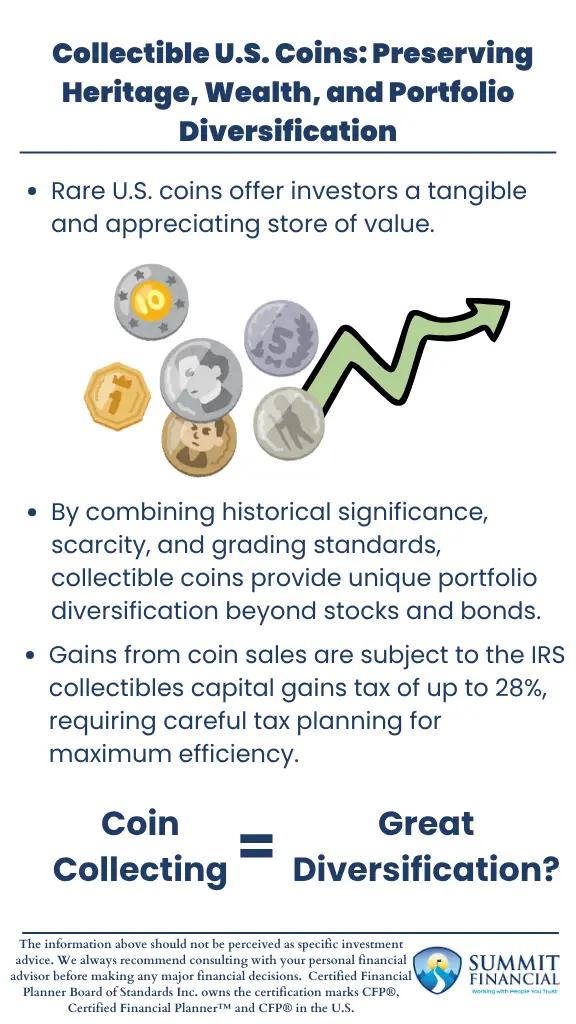
- Rare U.S. coins may offer investors a tangible and appreciating store of value.
- By combining historical significance, scarcity, and grading standards, collectible coins help provide unique portfolio diversification beyond stocks and bonds.
- Gains from coin sales are subject to the IRS collectibles capital gains tax of up to 28%, requiring careful tax planning for maximum efficiency.
Should You Consider Collectible Coins for Your Portfolio?
Collectible U.S. coins represent a unique alternative investment in 2026, blending historical significance with tangible value and long-term growth potential.
Including rare coins in a diversified portfolio allows investors to hedge against inflation, preserve wealth across generations, and gain exposure to a non-traditional asset class (PCGS).
Success depends on careful selection, verified grading, and trusted trading platforms. With due diligence, strategic planning, and attention to tax obligations, collectible coins can serve as both a heritage asset and a practical investment.
Questions About Alternative Investments?
If you have any questions about your investment portfolio, retirement planning, tax strategies, our 401(k) recommendation service, or other general questions, please give our office a call at (586) 226-2100.
Please feel free to suggest this blog post to a friend, family member, or co-worker. If you have had any changes to your income, job, family, health insurance, risk tolerance, or your overall financial situation, please give us a call so we can discuss it.
We hope you learned something today. If you have any feedback or suggestions, we would love to hear them.
Best Regards,
Daniel A. Ladzinski, CRPC®, AWMA®
with contributions by Robert L. Wink, Kenneth R. Wink, James D. Wink, Zachary A. Bachner, CFP® and James C. Baldwin
Daniel Ladzinski
A financial advisor at Summit Financial Consulting, Daniel graduated summa cum laude from Hillsdale College with a B.S. in Financial Management and Applied Mathematics in 2024. He has obtained several licenses, including the Series 7, Series 63, Series 65, Variable Life and Annuity Contracts, as well as Life, Health & Accident Insurance. Daniel has experience in several wealth management companies in the surrounding area. Each of these positions helped solidify his desire to serve clients and utilize his background in mathematics to pursue optimal financial plans. During his time in college, Daniel honed his analytical skills through active participation in the Hillsdale College Applied Mathematics Club. His strong interest in personal investing led him to develop specialized watchlists, alerts, and strategies, demonstrating his ability to create data-driven solutions. Among his many hobbies, Daniel is an avid multi-instrumentalist. He led the Hillsdale College Big Band on the saxophone, and he is currently delving into the music community of metro Detroit. He is also passionate about soccer, volleyball, disc golf, botany, numismatics, and, most importantly, his Catholic faith, family, and friends.
Sources
- CoinDesk - The rise of blockchain in numismatics: Tracking rare coins digitally (2023)
- Internal Revenue Service - Topic No. 409: Capital gains and losses (2023)
- Professional Coin Grading Service - Guide to investing in rare coins (2023)
- Stack's Bowers Galleries - Investing in rare coins: Trends and strategies (2021)
- Yeoman, R. S. - A guide to U.S. coins: History, grading, and collecting. Whitman Publishing (2022)