

Goal-Based Investing: A Fulfilling Approach to Building Wealth

Constructing a sound investment strategy requires more than choosing a few funds and hoping for the best. It involves understanding the purpose of each dollar, selecting the right type of account, and ensuring the investment approach aligns with both your goals and your timeframe.
A thoughtful strategy reduces confusion and stress, but building that strategy requires attention to detail and, for many people, professional guidance.
A crucial starting point is acknowledging that not all goals share the same time horizon and therefore should not be invested in the same way. An investor saving for a vacation next month has fundamentally different needs than someone saving for a home in three years, or for retirement decades in the future.
Short-Term Goals: Prioritizing Capital Preservation
Very short-term goals, such as a vacation in a few weeks or a planned purchase within the next several months, typically require capital preservation. Funds earmarked for these purposes often belong in stable vehicles such as high-yield savings accounts, money-market funds, or short-term Treasury bills.
In these cases, volatility can be harmful. Even a modest market downturn could interfere with the purpose of the funds.
Intermediate Goals: Balancing Growth and Stability
Intermediate goals, such as saving for a home over the next two to five years, require a more balanced approach. Investors often need some growth to keep pace with rising costs while still limiting downside risk.
A blended strategy, such as conservative bond funds, short-duration fixed income, or modest equity exposure, may help support progress while preserving flexibility as the purchase date approaches.
Long-Term Goals: Leveraging Time and Market Growth
Long-term objectives, such as retirement, allow for a broader range of investment opportunities. Investors with decades ahead of them can typically tolerate short-term market fluctuations in exchange for higher long-term growth potential.
Equities, global diversification, and tax-advantaged accounts such as 401(k)s and IRAs often play a central role. Over periods of 20 or 30 years, disciplined exposure to market growth has historically been one of the most effective ways to build substantial wealth (Vanguard – Advisor’s Alpha).
Why Investor Behavior Often Matters More Than Investments
Understanding what to invest in is only part of the equation. Investors must also choose appropriate account types, manage tax considerations, maintain diversification, contribute consistently, rebalance periodically, and avoid emotional reactions to market movements.
Research shows this is where many individuals struggle. DALBAR’s Quantitative Analysis of Investor Behavior demonstrates that investors often underperform due to reactive decisions and poor timing (DALBAR QAIB).
Morningstar’s Mind the Gap research similarly highlights the difference between investor returns and fund returns, driven largely by inconsistent behavior and attempts to time the market (Morningstar Annual Report).
Role of Professional Guidance
These challenges underscore why many investors benefit from working with a financial professional who brings structure, clarity, and discipline to the process.
While passive index funds can serve as foundational building blocks, the ongoing management of a portfolio is where complexity re-emerges. Over time, allocations drift, risk profiles evolve, tax situations change, and new goals emerge.
Markets shift in ways that require interpretation and response, not merely observation.
Understanding Goal-Based Investing: Key Takeaways
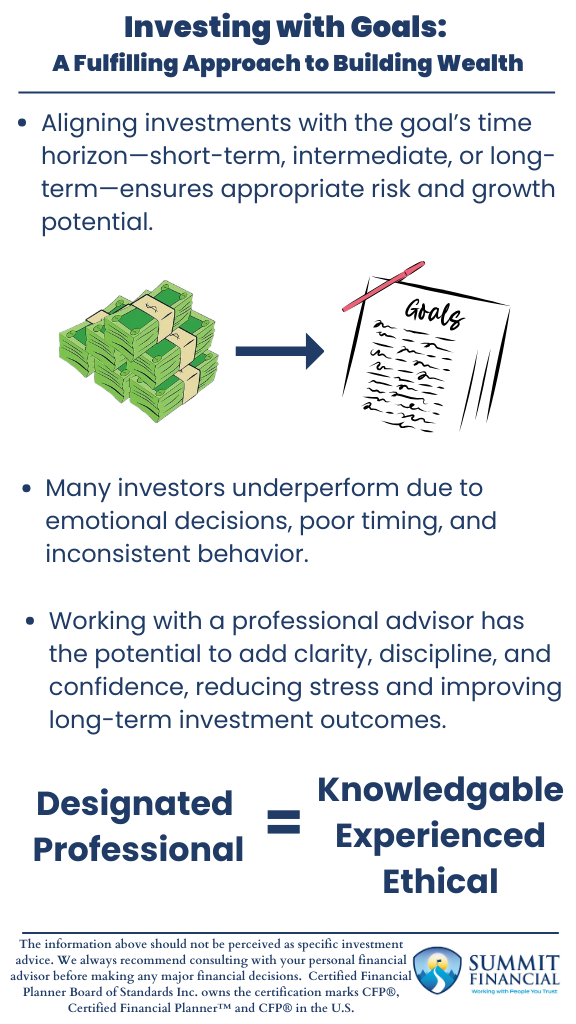
- Aligning investments with a goal’s time horizon, short-term, intermediate, or long-term, helps ensure appropriate risk and growth potential.
- Many investors underperform due to emotional decisions, poor timing, and inconsistent behavior.
- Working with a professional advisor can add clarity, discipline, and confidence, helping improve long-term investment outcomes.
Questions About Your Portfolio?
If you have any questions about your investment portfolio, retirement planning, tax strategies, our 401(k) recommendation service, or other general questions, please give our office a call at (586) 226-2100. Please feel free to forward this commentary to a friend, family member, or co-worker.
If you have had any changes to your income, job, family, health insurance, risk tolerance, or your overall financial situation, please give us a call so we can discuss it.
We hope you learned something today. If you have any feedback or suggestions, we would love to hear them.
Best Regards,
Daniel A. Ladzinski
with contributions by Robert L. Wink, Kenneth R. Wink, James D. Wink, Zachary A. Bachner, CFP® and James C. Baldwin
Daniel Ladzinski
A financial advisor at Summit Financial Consulting, Daniel graduated summa cum laude from Hillsdale College with a B.S. in Financial Management and Applied Mathematics in 2024. He has obtained several licenses, including the Series 7, Series 63, Series 65, Variable Life and Annuity Contracts, as well as Life, Health & Accident Insurance. Daniel has experience in several wealth management companies in the surrounding area. Each of these positions helped solidify his desire to serve clients and utilize his background in mathematics to pursue optimal financial plans. During his time in college, Daniel honed his analytical skills through active participation in the Hillsdale College Applied Mathematics Club. His strong interest in personal investing led him to develop specialized watchlists, alerts, and strategies, demonstrating his ability to create data-driven solutions. Among his many hobbies, Daniel is an avid multi-instrumentalist. He led the Hillsdale College Big Band on the saxophone, and he is currently delving into the music community of metro Detroit. He is also passionate about soccer, volleyball, disc golf, botany, numismatics, and, most importantly, his Catholic faith, family, and friends.