
How Rising Oil Prices Impact the Economy in 2026

The ongoing war with Iran as well as the volatility in oil prices has sparked some questions among our clients. Because of this curiosity, we found it fitting to write a piece on how the price of oil may impact the economy. We believe the impacts of war are more commonly understood, but the impact of oil prices might be more of an unknown.
How Do Oil Prices Affect Consumer Costs?
Oil prices are typically felt most personally by consumers when we fill up at the pump, but high oil prices can also cause other goods to increase in cost as well. We believe this is the case because you pay for gas by the gallon and the price of gas is very clearly labeled at every station.
Every gas station you drive by displays the current price and if you take a similar route every day to work then you may be able to notice trends in those prices over time.
However, consumers will likely feel additional strain on their wallets when making non-oil purchases. This is due to the potential increase in broad inflation data and we believe this is caused by the higher cost of goods from manufacturers being passed down to the consumer (Investopedia).
If a company has to ship in their raw materials and then ship out their finished good, those transportation costs will be higher if oil prices are higher. This increase in transportation costs could be passed to the consumer through the increase of prices for end products, thus resulting in higher inflation broadly.
Forbes has stated that a 5% increase in oil prices results in a 0.1% increase in inflation (Forbes).
How Might the Federal Reserve Respond to Oil-Driven Inflation?
The next impact that might be seen is if the Federal Reserve decides to take action to potentially combat this rise in inflation. Higher interest rates could help combat inflation but could also hinder growth in the US economy.
Higher rates are part of a tightening policy trend because higher rates mean it is more expensive to finance expenses, so less expenses can be afforded.
Whether this is on the consumer or the producer side, higher rates tend to lead towards a slowdown in purchases. Oil companies may increase hiring to take advantage of these higher prices, but non-oil employers may slow hiring if they cannot receive affordable financing options (Investopedia).
How Do High Oil Prices Impact Global Trade?
Lastly, the US may be impacted by other countries that are not able to export as much oil as we can. The US will benefit from the higher price of our exported oil, but other countries may suffer from the higher price of their imported oil. This means that other countries may face steeper economic slowdowns or possibly recessions.
And if other countries face these struggles then they are less likely to import other non-oil US goods (Forbes). This ripple effect could cause other non-oil industries to struggle as we may see an overall decrease in exports.
What Should Investors Consider During Oil Price Volatility?
We are going to maintain a close eye on the geopolitical events as they unfold and will react as we see necessary within our portfolios for our clients. As it relates to budgeting concerns, we believe clients should be aware that inflation may be back on the rise if oil prices maintain their current levels.
As prices escalate, it may be a good time to review your budget to see if you can remove or minimize other expenses to allow for the increase in price for the mandatory expenses.
Key Takeaways
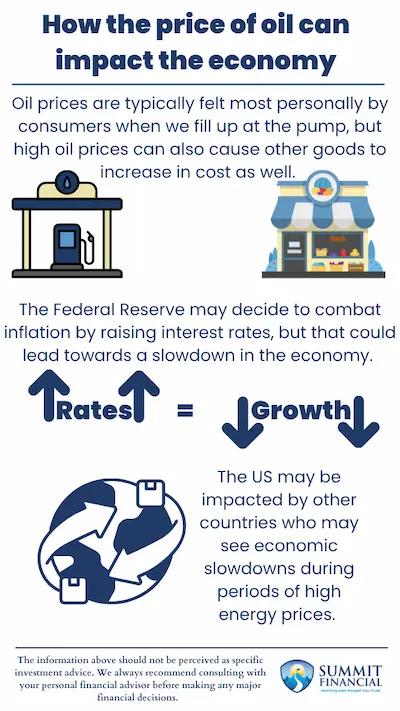
- Oil prices are typically felt most personally by consumers when we fill up at the pump, but high oil prices can also cause other goods to increase in cost as well.
- The Federal Reserve may decide to combat inflation by raising interest rates, but that could lead towards a slowdown in the economy.
- The US may be impacted by other countries who may see economic slowdowns during periods of high energy prices.
Questions About Your Portfolio or Market Volatility?
If you have any questions about your investment portfolio, retirement planning, tax strategies, our 401(k) recommendation service, or other general questions, please give our office a call at (586) 226-2100.
Please feel free to suggest this blog post to a friend, family member, or co-worker. If you have had any changes to your income, job, family, health insurance, risk tolerance, or your overall financial situation, please give us a call so we can discuss it.
We hope you learned something today. If you have any feedback or suggestions, we would love to hear them.
Best Regards,
Zachary A. Bachner, CFP®
with contributions from Robert L. Wink, Kenneth R. Wink, and James D. Wink.
Zach Bachner
After graduating from Central Michigan University in 2017 with specialized degrees in Finance and Personal Financial Planning, Zachary “Zach” Bachner set himself apart by earning the CFP® designation and passing the Series 7, 63, 65 licensing exams early in his career. Zach gained valuable real-world experience with the team at Summit Financial Consulting, who treated him like family. Their guidance helped him refine his skills in practical, client-centered planning, where putting their needs first was non-negotiable. This focus on trust-building not only allowed him to cultivate strong relationships, but also allowed him to continue doing what he loves most: solving client problems through efficient financial planning strategies. Leveraging his experience, Zach now helps others navigate finances through clear, informative writing. His work has been published in major outlets like Yahoo Finance, MarketWatch, and Investment Business Daily, establishing him as a valued resource. By simplifying complex topics, Zach aims to empower everyday people to confidently pursue their financial goals