

Passive Income Strategies: Choosing the Right One for Your Financial Goal

One way to increase your net worth and annual income is to pursue a passive income strategy. Passive Income may be beneficial because you do not need to put in the time or work on your end to generate the income stream.
You simply need to invest some of your own capital and allow your money to start working for you. This type of strategy may be beneficial because you can work your existing job while utilizing these investments to create an additional income stream. This extra income can be used to cover expenses or can be used to save and invest towards a future goal.
Why Consider Passive Income?
Many investors have the eventual goal of creating enough passive income to replace their full-time employment. This can help lead to financial independence and possibly an early retirement. However, passive income is not the best option for everyone since each strategy does have its pros and cons.
For example, passive income may require a sizable investment on the front end, or it may result in fluctuating income amounts that may even result in periods of zero income. We highly recommend consulting with your personal financial advisor before committing to an investment since it is likely to have an impact on your overall financial plan.
We’ve also covered other effective ways to boost your income, check out our previous discussion on Strategies to Increase Monthly Income.
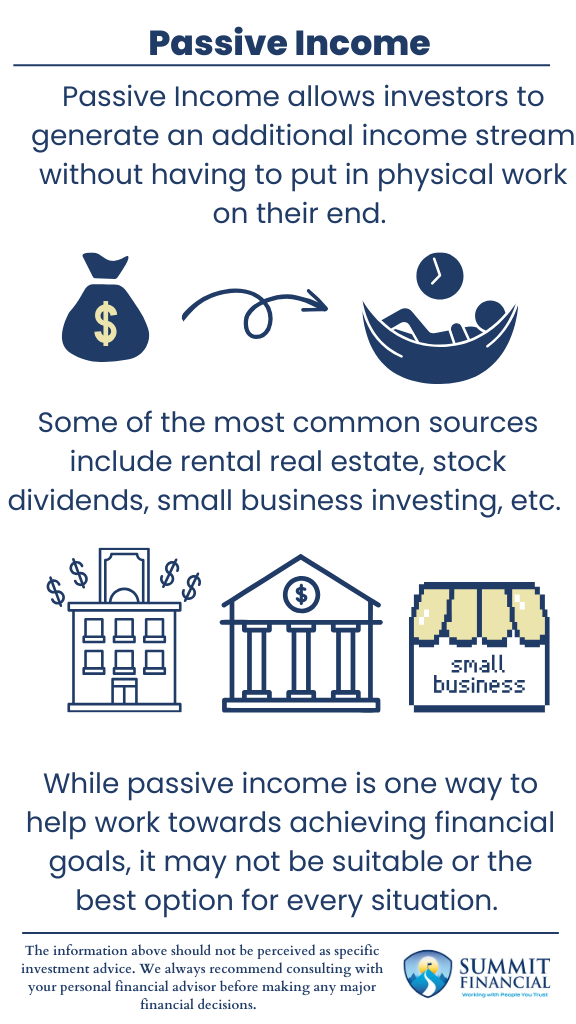
!Infographic illustrating passive income sources, including rental real estate, dividend stocks, and small business investing.
Popular Passive Income Strategies
1. Rental Real Estate
Among our clients, Rental Real Estate is by far one of the most common Passive Income strategies. However, for the income to be passive, minimal work must be performed by the investor. This means that the property cannot require a lot of upkeep or repairs that are completed by the owner.
Using a 3rd party property manager to help run the renal property is a great way to ensure the investor does not put in more work than needed. Since a mortgage can be acquired to buy a rental property, less capital may be required up front to achieve this revenue stream.
However, this means that debt would be required, and leverage always increases the risk of a strategy since you are obligated to make monthly payments whether or not you have a renter currently in the property.
2\. Dividend-Paying Investments
We believe a much simpler and perhaps less exciting way to create passive income is to buy a dividend-paying investment. This could be stocks that pay a recurring dividend, bonds that pay a regular coupon amount, or an ETF or Mutual Fund that distributes the underlying dividends.
By investing in these types of securities, you will receive periodic payments from the owned assets. Equity dividends can fluctuate based on the performance of the underlying company or security so future dividends are never guaranteed.
Also, the amount of passive income derived from dividends or bond payments can be relatively low, so a larger amount of capital may be required to achieve similar outcomes of other passive strategies. The value of the underlying stock or bond can fluctuate, which may help or hurt your investment portfolio depending on the direction of the price changes.
3\. Small Business or Angel Investing
The last strategy we wanted to mention is small business investing, or angel investing. This is when a small business or sometimes just a potential business seeks out investments from others to grow their business.
Angle Investing is when someone helps fund a company at the very early stages. However, small businesses may be looking for investors from time to time whether they are just starting out or perhaps trying to expand current operations.
In either case, the investor typically receives partial ownership in the company and has a right to future profits. These profits are typically received as a passive income stream unless the investor plays a bigger role in the company than just a source of funds.
This type of investment is often considered high risk since the future can be very unclear for a small business. Will the investment help the company’s profits? Or will the funds be used simply to plug the holes of a sinking ship?
## Is Passive Income Right for You?
- Passive income allows investors to generate an additional income stream without having to put in physical work on their end.
- Some of the most common sources include rental real estate, stock dividends, small business investing, etc.
- While passive income is a great way to achieve financial goals, it may not be suitable or the best option for every situation.
Speak With a Trusted Advisor
If you have any questions about your investment portfolio, retirement planning, tax strategies, our 401(k) recommendation service, or other general questions, please give our office a call at (586) 226-2100.
Please feel free to forward this commentary to a friend, family member, or co-worker. If you have had any changes to your income, job, family, health insurance, risk tolerance, or your overall financial situation, please give us a call so we can discuss it.
We hope you learned something today. If you have any feedback or suggestions, we would love to hear them.
Best Regards,
Zachary A. Bachner, CFP®
with contributions from Robert Wink, Kenneth Wink, James Wink, James Baldwin
**
Zach Bachner
After graduating from Central Michigan University in 2017 with specialized degrees in Finance and Personal Financial Planning, Zachary “Zach” Bachner set himself apart by earning the CFP® designation and passing the Series 7, 63, 65 licensing exams early in his career. Zach gained valuable real-world experience with the team at Summit Financial Consulting, who treated him like family. Their guidance helped him refine his skills in practical, client-centered planning, where putting their needs first was non-negotiable. This focus on trust-building not only allowed him to cultivate strong relationships, but also allowed him to continue doing what he loves most: solving client problems through efficient financial planning strategies. Leveraging his experience, Zach now helps others navigate finances through clear, informative writing. His work has been published in major outlets like Yahoo Finance, MarketWatch, and Investment Business Daily, establishing him as a valued resource. By simplifying complex topics, Zach aims to empower everyday people to confidently pursue their financial goals
Related Articles
- How Do Bull Markets and Bear Markets Differ
- Navigating College Funding
- Financial Planning Mistakes to Avoid
- Tax Filing Explained
Sources:
- https://www.investopedia.com/terms/r/rateofchange.asp#:~:text=Rate%20of%20change%20(ROC)%20refers,and%20identify%20momentum%20in%20trends%20refers,and%20identify%20momentum%20in%20trends).
- https://www.khanacademy.org/math/algebra/x2f8bb11595b61c86:functions/x2f8bb11595b61c86:average-rate-of-change/v/introduction-to-average-rate-of-change
- https://www.investopedia.com/terms/m/momentum.asp
- https://ycharts.com/indicators/us\_inflation\_rate#:~:text=US%20Inflation%20Rate%20is%20at,long%20term%20average%20of%203.27%25