
What is Quantum Computing and Why Are Investors Paying Attention?

As 2026 unfolds, the world stands at a technological crossroads: traditional silicon-based computing is approaching physical limits, while quantum computing and artificial intelligence (AI) are rapidly converging.
This hybrid paradigm, often called quantum-enhanced AI, seeks to marry quantum machines with the pattern-recognition and predictive strengths of AI.
The result is a new class of computational tools capable of tackling problems that were previously infeasible, from optimizing supply chains to accelerating drug discovery.
Quantum computing harnesses principles of quantum mechanics such as superposition and entanglement to process information in fundamentally new ways. While fully fault-tolerant quantum computers remain in development, near-term hybrid architectures that combine classical and quantum processors are already emerging, enabling researchers and companies to explore real-world applications today.
Which Industries Could Quantum Computing Transform?
The fusion of quantum computing and AI could transform multiple sectors:
- Scientific Discovery and Materials Design: Quantum-AI models can simulate molecular and atomic systems with greater efficiency, potentially speeding up breakthroughs in energy, chemistry, and medicine (Scientific Reports).
- Optimization and Logistics: Complex optimization tasks, from global supply networks to traffic flows, could see substantial performance improvements using quantum-aware algorithms.
- Machine Learning: Quantum processors can represent and manipulate information in ways that complement classical neural networks, potentially reducing training time for large models (IonQ).
Major tech players are already gearing up: companies like Microsoft project that quantum machines could begin solving "impossible" calculations by 2029, suggesting a near-future roadmap where quantum-AI becomes commercially relevant.
Is Quantum Computing Real or Just Hype?
Several key trends signal that quantum-enhanced AI is more than just theoretical:
- Hybrid Quantum-Classical Computing Models: These models are gaining traction, allowing specific computational tasks to be offloaded to quantum processors while classical systems handle the rest—accelerating research and improving performance (IonQ Blog).
- Investment and Infrastructure Expansion: Global initiatives are already underway, including high-performance computing initiatives in Europe to support both AI and quantum technologies as strategic economic assets.
- Industry Projections: Firms like Microsoft suggest practical quantum advantages for businesses and science could materialize within just a few years.
What Are the Challenges and Ethical Considerations?
Despite the promise, quantum-enhanced AI also brings important challenges:
- Technological Readiness: Quantum processors are still early-stage and significant engineering hurdles remain before large-scale, fault-tolerant machines are realized.
- Workforce and Skill Gaps: The intersection of quantum physics and AI demands new expertise, requiring further investment in education and retraining.
- Security and Ethical Concerns: Quantum computing threatens current cryptographic systems, while advanced AI raises new ethical and privacy concerns. As with AI regulation (e.g., the EU AI Act and global initiatives), coherent frameworks may prove to be essential in ensuring responsible development and international coordination.
Should Investors Pay Attention to Quantum Computing?
Quantum-enhanced AI represents one of the most exciting frontiers of innovation in 2026. By blending the unique strengths of quantum mechanics with cutting-edge AI, this emerging discipline promises to unlock computational capabilities far beyond today's systems. It could potentially revolutionize science, industry, and everyday life. However, its success hinges on thoughtful design, global cooperation, ethical governance, and investments in human capital.
For investors, quantum-enhanced AI presents a compelling opportunity. Early exposure to companies developing quantum hardware, hybrid AI-quantum software, and specialized services could position portfolios to benefit from exponential growth in computational capabilities.
As with any frontier technology, the risks are significant, so a diversified and informed investment approach is essential. Balancing optimism with caution will allow stakeholders to harness the benefits while navigating the uncertainties of this transformative technology.
Key Takeaways
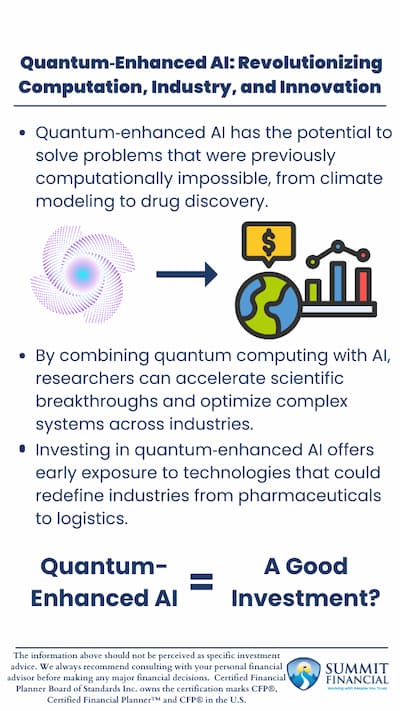
- Quantum-enhanced AI has the potential to solve problems that were previously computationally impossible, from climate modeling to drug discovery.
- By combining quantum computing with AI, researchers can accelerate scientific breakthroughs and optimize complex systems across industries.
- Investing in quantum-enhanced AI offers early exposure to technologies that could redefine industries from pharmaceuticals to logistics.
Questions About Technology Investments?
If you have any questions about your investment portfolio, retirement planning, tax strategies, our 401(k) recommendation service, or other general questions, please give our office a call at (586) 226-2100.
Please feel free to suggest this blog post to a friend, family member, or co-worker. If you have had any changes to your income, job, family, health insurance, risk tolerance, or your overall financial situation, please give us a call so we can discuss it.
We hope you learned something today. If you have any feedback or suggestions, we would love to hear them.
Best Regards,
Daniel A. Ladzinski, CRPC®, AWMA®
with contributions by Robert L. Wink, Kenneth R. Wink, James D. Wink, Zachary A. Bachner, CFP® and James C. Baldwin
Daniel Ladzinski
A financial advisor at Summit Financial Consulting, Daniel graduated summa cum laude from Hillsdale College with a B.S. in Financial Management and Applied Mathematics in 2024. He has obtained several licenses, including the Series 7, Series 63, Series 65, Variable Life and Annuity Contracts, as well as Life, Health & Accident Insurance. Daniel has experience in several wealth management companies in the surrounding area. Each of these positions helped solidify his desire to serve clients and utilize his background in mathematics to pursue optimal financial plans. During his time in college, Daniel honed his analytical skills through active participation in the Hillsdale College Applied Mathematics Club. His strong interest in personal investing led him to develop specialized watchlists, alerts, and strategies, demonstrating his ability to create data-driven solutions. Among his many hobbies, Daniel is an avid multi-instrumentalist. He led the Hillsdale College Big Band on the saxophone, and he is currently delving into the music community of metro Detroit. He is also passionate about soccer, volleyball, disc golf, botany, numismatics, and, most importantly, his Catholic faith, family, and friends.
Sources
- Al Shammri, K. F., Al-Shareeda, A. A., Abdulnasser, A. J., Mohammed, A. A., & AlAli, R. (2026). Quantum-Enhanced AI and machine learning: Transforming predictive analytics. Recent Advances in Electrical & Electronic Engineering.
- Gupta, B. B., Pan, S.-H., Gaurav, A., Arya, V., Attar, R. W., Alhazmi, A. H., … Chui, K. T. (2025). Phishing threat mitigation in e-commerce using a quantum-enhanced hybrid AI framework. Scientific Reports.
- Acampora, G., Ambainis, A., Ares, N., Banchi, L., Bhardwaj, P., Binosi, D., … Wilhelm, F. K. (2025). Quantum computing and artificial intelligence: Status and perspectives.
- IonQ. (2025, May 1). IonQ demonstrates quantum-enhanced applications advancing AI. Business Wire.
- IonQ. (2024). Supercharging AI with quantum computing: Quantum-enhanced large language models. IonQ Blog.