
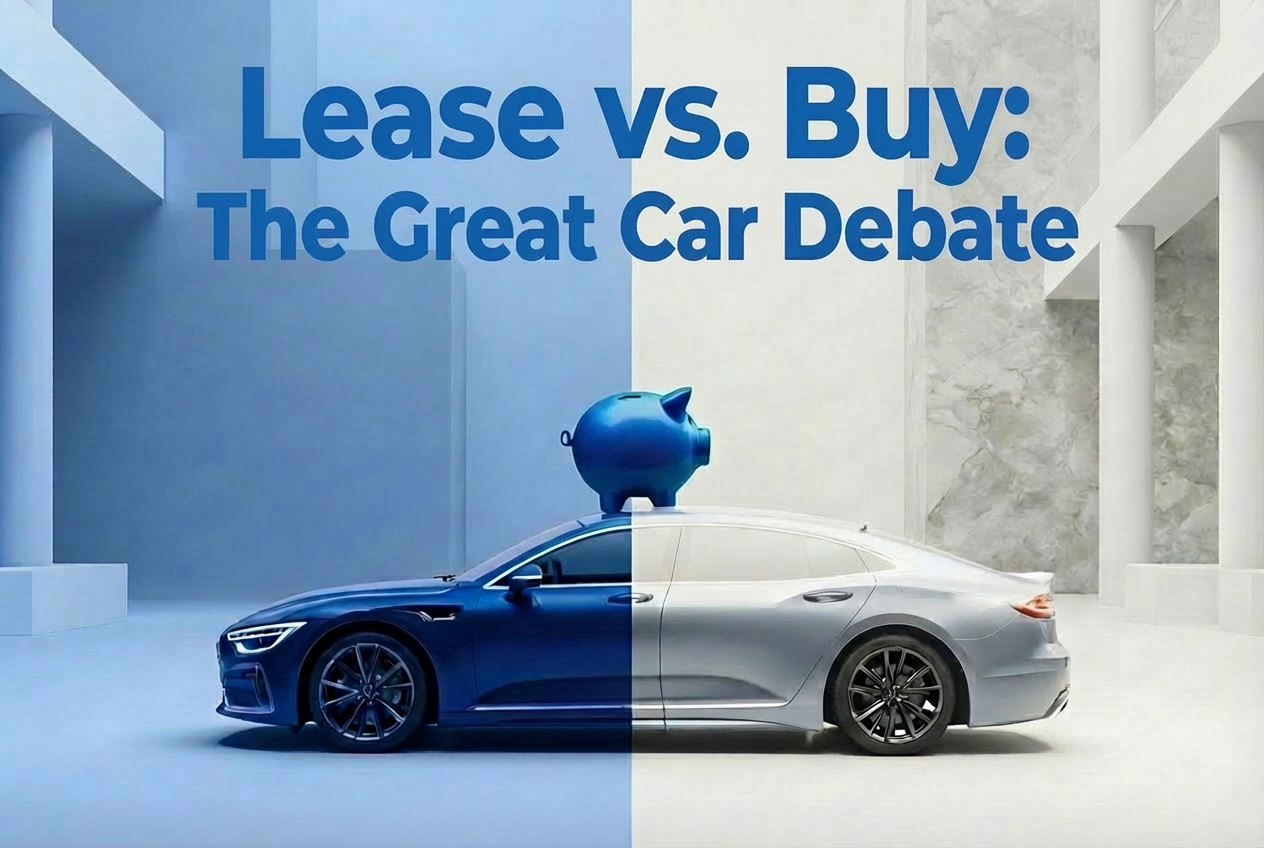
Should You Lease vs. Buy a New Car - Which Is Right for You?

It's the question I get asked all the time: "Should I lease my next car, or just buy it?"
Because I'm a financial advisor, people usually expect me to pull out a spreadsheet and prove that one is mathematically superior. But after years of looking at the numbers, I've realized that while the math matters, the "best" choice usually comes down to your personal lifestyle and how you value your time.
Here is the breakdown of the Pros & Cons.
The Case for Leasing: "The New Car Experience"
Leasing is essentially a long-term rental. You aren't paying for the car; you're paying for the depreciation that happens while you drive it.
- The Pros: Lower monthly payments, minimal down payments, and you're always under a manufacturer's warranty. If you love having the latest safety tech and that "new car smell" every three years, leasing is the most convenient way to get it.
- The Cons: You are trapped in a cycle of perpetual payments. You also have to watch your mileage like a hawk and keep the interior pristine to avoid "excess wear and tear" fees at the end.
The Case for Buying: "The Long-Term Equity"
When you buy (whether cash or finance), you are building equity and you retain ownership of the vehicle and any remaining resale value.
- The Pros: Eventually, the payments stop. Once that loan is clear, you have a "free" car that you can drive into the ground or sell for cash. You have total freedom—no mileage limits and no one to answer to if you spill coffee on the seats.
- The Cons: Higher monthly payments and the "Depreciation Hit." A new car can lose 20% of its value the moment you drive it off the lot. Plus, once the warranty expires, every weird engine noise is coming out of your pocket.
My Personal Preference (And Why It Might Not Be Yours)
Clients often ask what I do. My personal preference is buying used.
I typically look for a vehicle that is 3–4 years old. Why? Because the previous owner already "paid" for the steepest part of the depreciation curve.
I get a reliable, modern vehicle at sometimes 30–40% below the original sticker price, and I plan to keep it for 7–10 years. For me, the "win" is the years of driving with zero monthly payments.
But that's just me.
If you are a high-mileage driver, leasing will penalize you. If you are a tech-lover who gets bored of a car after 24 months, buying used might feel like a chore.
The Bottom Line
There is no "right" answer, only the answer that fits your cash flow and your temperament. If you value predictability and newness, lease. If you value long-term ownership and equity, buy.
Connect With Us
If you have any questions about your investment portfolio, retirement planning, tax strategies, our 401(k) recommendation service, or other general questions, please give our office a call at (586) 226-2100. Please feel free to forward this commentary to a friend, family member, or co-worker.
If you have had any changes to your income, job, family, health insurance, risk tolerance, or your overall financial situation, please give us a call so we can discuss it.
We hope you learned something today. If you have any feedback or suggestions, we would love to hear them.
Best Regards,
James Baldwin
This content is for educational purposes only and is not intended as personalized financial advice. Individual circumstances vary, and readers should evaluate their own situation before making financial decisions.
James Baldwin
James is an Advisor at Summit Financial Consulting, LLC. He graduated from Michigan State University with a B.A. in Finance in 2021. With extensive licensing that includes the Series 7, Series 65, Series 63, and Life, Health, & Accident, James is a core member of our advisory team dedicated to creating transparent financial strategies for our clients. During his time at MSU, he was actively involved in student investment groups, including the Student Investment Association and the Student Venture Capital Fund Group. Outside of the office, he enjoys playing golf and going on various trips and adventures with his friends.