

Should You Give Now or Invest First? Charitable Giving Guide

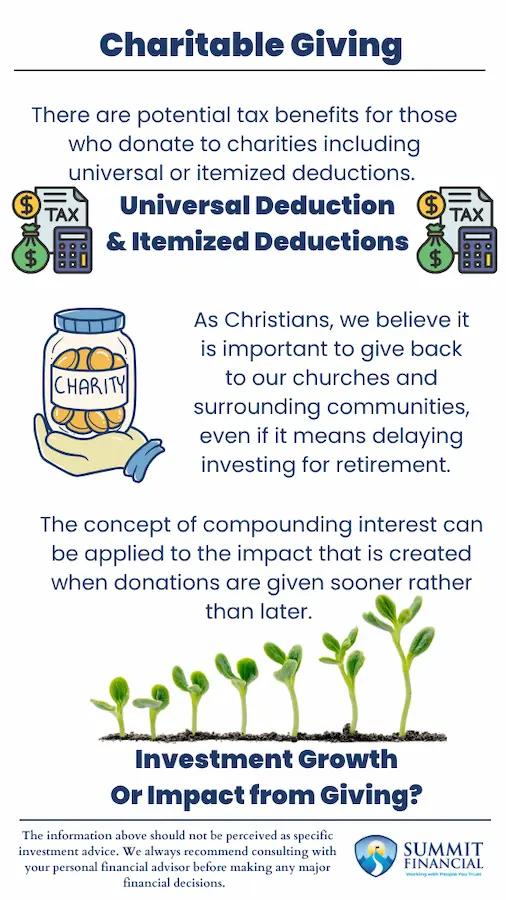
There are potential tax benefits for those who donate to charities including universal or itemized deductions. As Christians, we believe it is important to give back to our churches and surrounding communities, even if it means delaying investing for retirement.
The concept of compounding interest can be applied to the impact that is created when donations are given sooner rather than later.
Why Do We Believe in Charitable Giving?
Here at Summit Financial, we love to help clients plan for their financial goals, especially when those goals include charitable donations.
As Christians, we believe it is important to give back to our churches and surrounding communities. We believe time can be a valuable donation as well if you are able to volunteer but cannot give financially.
We normally try to separate business from politics and religion, but I do want to take a quick second to share one quote from the Bible regarding tithing that seems to motivate individuals to start giving or to give more:
Malachi 3:10 (NIV): "'Bring the whole tithe into the storehouse, that there may be food in my house. Test me in this,' says the Lord Almighty, 'and see if I will not throw open the floodgates of heaven and pour out so much blessing that there will not be room enough to store it.'"
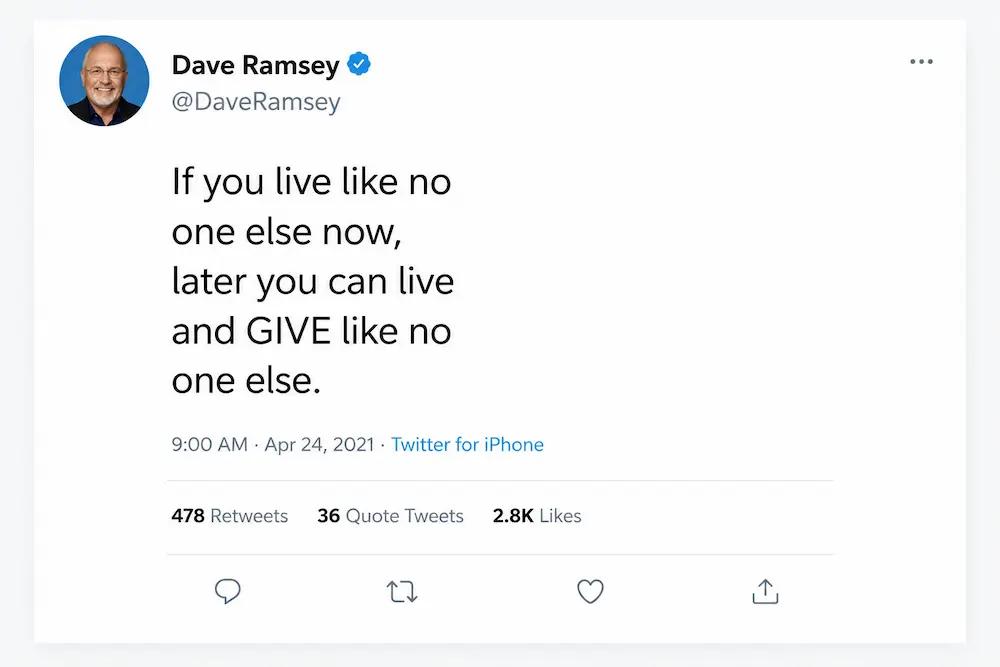
Photo Credit: Ramsey
We have clients that commonly quote Dave Ramsey and his Baby Step plan, but one of his most popular quotes is "Live like no one else now, so later you can live and give like no one else." As passionate Christians, we would argue that one should "Give like no one else now, so later they could live like no one else." The decision to tithe or donate can be a very stressful and emotional decision, but we truly believe the Lord will provide for those who follow him.
Why Does the Math Say to Invest Instead of Give?
We believe clients tend to struggle with charitable donations because the math does not necessarily support donating. Financial plans are stronger when assets are retained within the plan and are used to cover expenses or are invested for growth. We discussed the concept of compounding interest in our previous blog about time value of money.
The idea is that the sooner you start investing, the more time is on your side, and the more compounded growth you could potentially earn over time. For a hypothetical example:
- Year 1: $100 invested at 10% growth would be a $10.00 return.
- Year 2: $110 invested at 10% growth would be an $11.00 return.
- Year 3: $121 invested at 10% growth would be a $12.10 return.
As you can see, the growth in the account continues to grow over time. And despite no further contributions, the account would earn more and more every year as that growth compounds upon itself.
How Does Charitable Giving Create Its Own Compounding Interest?
We believe a similar result can be seen through charitable donations. Here is a hypothetical example of the impact giving can create through programs such as our Summit Gives Back initiative.
Assumptions: It requires $1,000 to help an individual during hard times be able to avoid homelessness and to get their life back on track.
Scenario 1: $1,000 could grow to $2,600 if invested for 10 years and earns a 10% rate of return per year. ($1,000 x (1.1^10)) This $1,000 could grow and help almost 3 people in the future. It is possible the individual in this scenario wanted to save for their future but realized they were financially stable and wanted to begin donating in 10 years.
Scenario 2: $1,000 donated today would be able to help one individual avoid homelessness. Due to the generosity received, they are able to maintain consistent employment and eventually begins to start a family.
Near the 10 year mark, their life has fully turned around, and they begin giving to others as they personally see the value of helping those in the community. The family and friends of this individual are also able to see the benefit of giving and one act of generosity could inspire others to also give.
Whether it is donating to church, the local animal shelter, or even supporting our veterans – the charity will receive the impact of compounding interest within their organization.
Yes, you will not receive the compounded interest in your investment account, but your donation may have a much greater impact today than it would down the road after your money has grown a bit.
Consider the example above on how a homeless shelter could use your donation to help an individual get their life back on track, they end up with a job, then start a family. The small ripples of your donation today can create waves that could be larger than you could imagine over time.
What Are the Tax Benefits of Charitable Giving?
On top of the potential blessings one may receive, there are potential tax benefits for those who donate to charitable donations.
First, because of the new changes from the One Big Beautiful Bill, even those who do not itemize can deduct the first $1,000/$2,000 of donations for single/married tax filers (dafgiving360.org). We believe this change was implemented to help motivate individuals or couples to donate more than they were previously since they can receive the tax benefit even if they do not itemize their deductions. And for those who do itemize, they may be able to deduct a larger amount to receive a potentially larger tax benefit.
How Should You Balance Giving with Financial Planning?
The decision to donate to charity is a very personal and emotional decision. It will certainly vary from person to person, so we highly recommend discussing these goals with your financial advisor. An effective budget and a strong financial plan built with these goals in mind is achievable, but some other spending/investing sacrifices might need to be made. From our experience, a priority of only growing assets can lead towards greed while the goal of giving tends to lead towards a life of generosity.
If you feel inclined, please visit summitfc.net/community to learn more about our annual charitable goals. We have been partnering with the Gradient Gives Back foundation to help those in our community. You may donate to our fundraising efforts through Summit Gives Back to help us make a difference in our community.
(Summit Financial Consulting LLC and Gradient Gives Back foundation are unaffiliated entities.)
Key Takeaways
- There are potential tax benefits for those who donate to charities including universal or itemized deductions.
- As Christians, we believe it is important to give back to our churches and surrounding communities, even if it means delaying investing for retirement.
- The concept of compounding interest can be applied to the impact that is created when donations are given sooner rather than later.
Questions About Incorporating Charitable Giving Into Your Financial Plan?
If you have any questions about investing, tax strategies, our 401(k) recommendation service, or other general questions, please give our office a call at (586) 226-2100.
Please feel free to suggest this blog post to a friend, family member, or co-worker. If you have had any changes to your income, job, family, health insurance, risk tolerance, or your overall financial situation, please give us a call so we can discuss it.
We hope you learned something today. If you have any feedback or suggestions, we would love to hear them.
Best Regards,
Zachary A. Bachner, CFP®
with contributions from Robert L. Wink, Kenneth R. Wink, and James D. Wink.
Zach Bachner
After graduating from Central Michigan University in 2017 with specialized degrees in Finance and Personal Financial Planning, Zachary “Zach” Bachner set himself apart by earning the CFP® designation and passing the Series 7, 63, 65 licensing exams early in his career. Zach gained valuable real-world experience with the team at Summit Financial Consulting, who treated him like family. Their guidance helped him refine his skills in practical, client-centered planning, where putting their needs first was non-negotiable. This focus on trust-building not only allowed him to cultivate strong relationships, but also allowed him to continue doing what he loves most: solving client problems through efficient financial planning strategies. Leveraging his experience, Zach now helps others navigate finances through clear, informative writing. His work has been published in major outlets like Yahoo Finance, MarketWatch, and Investment Business Daily, establishing him as a valued resource. By simplifying complex topics, Zach aims to empower everyday people to confidently pursue their financial goals