
Global Cruise Industry: Investment Opportunities and Long-Term Outlook

As 2026 progresses, the global cruise industry has emerged as one of the strongest-performing segments of the tourism sector. Following years of recovery and expansion, cruise travel has reached record passenger volumes, reflecting robust consumer demand for leisure experiences and international travel.
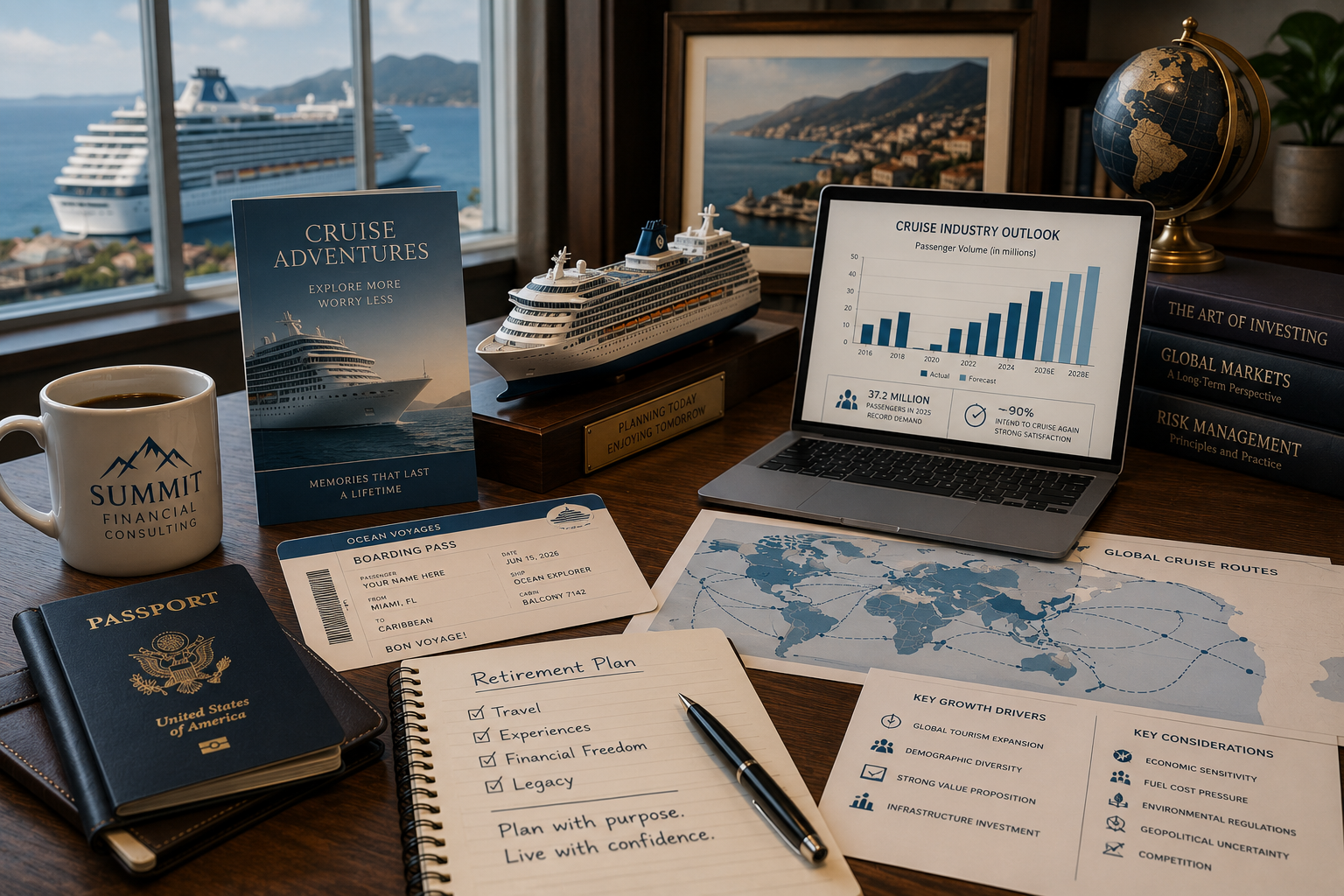
According to industry estimates, global cruise passenger volume reached approximately 37.2 million passengers in 2025, demonstrating the sector's continued resilience and growth (Cruise Lines International Association [CLIA], 2026).
Nearly 90% of cruise passengers also reported an intention to cruise again, highlighting strong customer satisfaction and repeat demand (CLIA, 2026).
This momentum has attracted significant investment throughout the industry. Cruise operators are expanding fleets, introducing new destinations, and investing in more efficient vessels designed to improve both passenger experiences and environmental performance (Deloitte, 2025).
At the same time, governments and port authorities are investing billions of dollars in terminal expansions, transportation networks, and tourism infrastructure to accommodate rising passenger volumes (Port of Galveston, 2026).
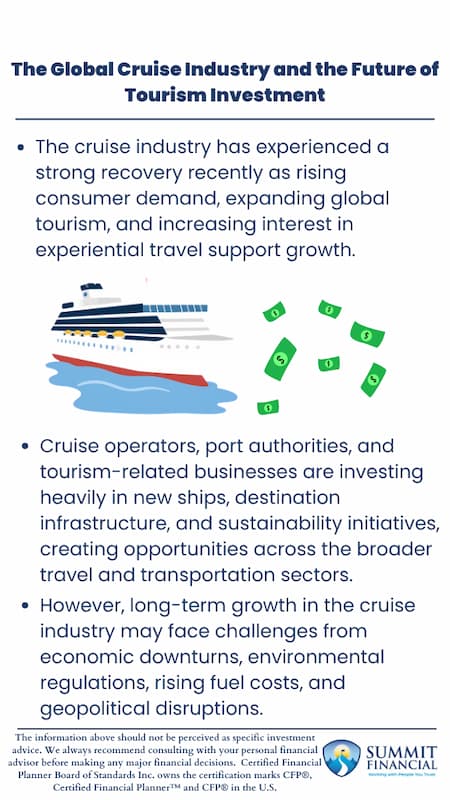
Despite these favorable trends, the long-term outlook for the cruise industry remains uncertain. We believe that economic conditions, environmental concerns, geopolitical events, and changing consumer preferences may influence future growth.
Understanding these factors is essential for investors, policymakers, and businesses connected to global tourism markets.
What Is Driving Growth in the Global Cruise Industry?
Several structural trends may continue to support demand for cruise travel. One of the most important drivers is the expansion of global tourism. International travel activity reached record levels in 2025, reflecting strong consumer willingness to spend on leisure experiences despite broader economic uncertainty (United Nations Tourism, 2026).
Cruise vacations can benefit from this trend because they combine transportation, accommodation, dining, and entertainment into a single travel package.
Demographic trends also contribute to industry growth. Retirees and older travelers continue to represent a significant portion of cruise passengers due to their disposable income and flexibility to travel.
However, cruise lines have increasingly attracted younger travelers and families through shorter itineraries, entertainment-focused experiences, and destination-based offerings. Industry reports indicate that the average cruise passenger has become younger in recent years as companies broaden their target markets (CLIA, 2026).
In addition, cruise travel often offers relatively strong value compared to traditional land-based vacations. As hotel, airfare, and entertainment costs continue to rise in many destinations, cruise packages remain attractive to consumers seeking predictable travel expenses and multiple-destination experiences (Deloitte, 2025).
This value proposition has helped sustain demand even during periods of inflation and economic uncertainty.
What Recent Investment Trends Are Shaping the Cruise Sector?
Investment activity across the cruise industry has accelerated substantially in recent years. Major cruise operators continue to order larger and more technologically advanced vessels while expanding destination offerings and private tourism developments.
Significant capital expenditures are being directed toward ship modernization, fuel-efficiency improvements, and enhanced onboard amenities (CLIA, 2026).
Infrastructure investment has also become a major driver of industry growth. Ports around the world are expanding terminals and transportation facilities to accommodate larger ships and rising passenger volumes.
For example, the Port of Galveston expects approximately 3.9 million passenger movements in 2026 and continues to invest heavily in terminal expansion and long-term infrastructure development (Port of Galveston, 2026). Similar investments are occurring in Europe, Asia, and the Caribbean as destinations seek to capture the economic benefits associated with cruise tourism.
Financial markets have generally responded positively to the industry's recovery. Major cruise companies have reported strong booking trends extending into 2027, reflecting continued consumer confidence and forward demand (Reuters, 2026a).
Industry forecasts suggest that passenger volumes could continue increasing throughout the remainder of the decade as additional ships enter service and new markets develop (CLIA, 2026).
At the same time, the sector remains highly capital intensive. New vessel construction requires substantial financial commitments, and profitability depends heavily on occupancy rates, consumer spending, and operational efficiency.
These characteristics create both opportunities and risks for investors.
What Challenges May Limit Future Cruise Industry Growth?
Although the long-term outlook for the cruise industry remains favorable, several factors could limit future growth and investment returns.
- Economic Sensitivity: The industry remains highly sensitive to economic conditions. Cruise vacations are discretionary purchases, meaning demand can weaken during periods of recession, rising unemployment, or declining consumer confidence. Economic slowdowns may reduce passenger volumes and pressure pricing across the industry (World Bank, 2025).
- Fuel Cost Pressure: Rising fuel costs represent a significant operational challenge. Fuel is one of the largest expenses for cruise operators, and recent geopolitical tensions have contributed to higher energy prices. Several major cruise companies have reported increased fuel expenses during 2026, which have affected earnings despite strong passenger demand (Reuters, 2026a); (Reuters, 2026b)).
- Environmental Regulations: Environmental regulations may increase costs over time. Governments and international regulatory organizations continue to introduce stricter emissions standards for maritime transportation. Compliance may require substantial investments in alternative fuels, cleaner propulsion systems, and advanced environmental technologies (International Maritime Organization, 2025). While these initiatives may improve sustainability, they could also reduce profit margins and increase capital expenditures.
- Geopolitical and Disruption Risks: Geopolitical instability and global disruptions can affect travel patterns. Regional conflicts, security concerns, public health events, and changes in international travel policies may alter consumer behavior and disrupt popular cruise routes. Such events can significantly affect bookings, operating costs, and investor sentiment (United Nations Tourism, 2026). While these challenges are unlikely to eliminate demand for cruise travel, they suggest that future growth may be more moderate and volatile than recent performance might indicate.
What Does the Cruise Industry Outlook Mean for Investors?
The cruise industry is likely to remain an important component of the global tourism economy. Rising travel demand, expanding tourism markets, and continued infrastructure investment provide strong foundations for long-term growth.
Record passenger volumes in 2025 and continued investment in ships and ports demonstrate the sector's resilience and economic significance (CLIA, 2026); (Port of Galveston, 2026)).
However, growth is unlikely to occur without setbacks. Economic cycles, environmental regulations, rising fuel costs, and geopolitical developments will all influence the industry's future trajectory (World Bank, 2025); (International Maritime Organization, 2025)). Ultimately, the cruise industry reflects the balance between growing global demand for travel experiences and the operational challenges associated with large-scale tourism infrastructure.
While the long-term outlook remains positive, a balanced expectation characterized by steady expansion alongside periods of volatility provides a more realistic assessment of the industry's future.
Cruise Industry Investment Opportunities - Key Takeaways
- The cruise industry has experienced record growth with 37.2 million passengers in 2025 and 90% repeat-visit intention rates, supported by expanding global tourism, demographic trends, and strong value propositions compared to traditional vacations.
- Significant investment is accelerating across cruise operators (new ships, technology, efficiency), port authorities (terminal expansions), and infrastructure - demonstrating confidence in long-term sector growth and economic significance.
- Cruise travel appeals to diverse demographics (retirees, younger travelers, families) and offers bundled vacation packages with predictable costs, creating resilient demand even during economic uncertainty.
- Economic sensitivity, rising fuel costs (major expense item), environmental regulations (compliance costs), and geopolitical disruptions (travel pattern changes) may constrain future growth and create periodic volatility.
- Long-term outlook remains constructive, but realistic expectations include steady growth with periodic setbacks rather than indefinite rapid expansion - balanced by economic cycles and operational challenges.
Questions About Your Investment Portfolio?
If you have any questions about your investment portfolio, retirement planning, tax strategies, our 401(k) recommendation service, or other general questions, please give our office a call at (586) 226-2100.
Please feel free to suggest this blog post to a friend, family member, or co-worker. If you have had any changes to your income, job, family, health insurance, risk tolerance, or your overall financial situation, please give us a call so we can discuss it.
We hope you learned something today. If you have any feedback or suggestions, we would love to hear them.
Best Regards,
Daniel A. Ladzinski, CFP®, CRPC®, AWMA®
with contributions by Robert L. Wink, Kenneth R. Wink, James D. Wink, Zachary A. Bachner, CFP®, and James C. Baldwin.
Disclaimer: This material is provided for informational and educational purposes only and should not be construed as investment, tax, or legal advice. Investing involves risk, including possible loss of principal. Past performance does not guarantee future results. Individuals should consult with a qualified financial professional before making financial decisions.
Daniel Ladzinski
A financial advisor at Summit Financial Consulting, Daniel graduated summa cum laude from Hillsdale College with a B.S. in Financial Management and Applied Mathematics in 2024. He has obtained several licenses, including the Series 7, Series 63, Series 65, Variable Life and Annuity Contracts, as well as Life, Health & Accident Insurance. Daniel has experience in several wealth management companies in the surrounding area. Each of these positions helped solidify his desire to serve clients and utilize his background in mathematics to pursue optimal financial plans. During his time in college, Daniel honed his analytical skills through active participation in the Hillsdale College Applied Mathematics Club. His strong interest in personal investing led him to develop specialized watchlists, alerts, and strategies, demonstrating his ability to create data-driven solutions. Among his many hobbies, Daniel is an avid multi-instrumentalist. He led the Hillsdale College Big Band on the saxophone, and he is currently delving into the music community of metro Detroit. He is also passionate about soccer, volleyball, disc golf, botany, numismatics, and, most importantly, his Catholic faith, family, and friends.
Sources
- Cruise Lines International Association (CLIA) - State of the Cruise Industry Report 2026
- Cruise Lines International Association (CLIA) - Cruise Industry Demand and Efficiency Investments
- Deloitte - 2025 Travel and Hospitality Industry Outlook
- International Maritime Organization (IMO) - Strategy on Reduction of Greenhouse Gas Emissions from Ships
- Port of Galveston - Port Expansion and Cruise Industry Growth Projections
- Reuters - Royal Caribbean Cruise Demand and Fuel Costs Impact
- Reuters - Carnival Profit Forecasts and Rising Fuel Costs
- United Nations Tourism - World Tourism Barometer
- World Bank - Global Economic Prospects