

Funeral Industry Investments: Cremation Trends & Market Opportunities

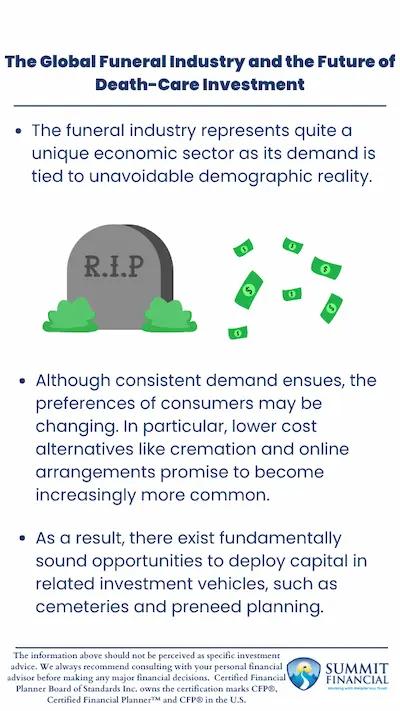
Whether it be as exciting as we'd like it to be, few industries are as consistent performers as the global death-care industry. In truth, demand for funeral and cemetery services is not dependent on consumer confidence, discretionary spending, or economic cycles. People all eventually require some form of death services regardless of if their finances and whether they are budgeted appropriately.
Why Is the Death-Care Industry Attractive to Investors?
In truth, this does not mean that the future of this industry is not subject to any change. In fact, one of the most significant transformations is occurring right now. Cremation is becoming overwhelmingly more popular than usual compared with traditional burial since families are seeking lower-cost alternatives.
The National Funeral Directors Association (NFDA) projects that the U.S. cremation rate will reach about 63.4% in 2025, compared with a projected burial rate of 31.6%. By 2045, cremation may likely account for 82.3% of dispositions, while burial is expected to decline to only 13.0% (NFDA, 2025). In addition, technology is changing the way funeral services are arranged and experienced.
These trends have attracted investors and large corporations seeking to build scale in the death-care market. Service Corporation International (SCI), the largest death-care provider in North America, operated 1,495 funeral service locations and 505 cemeteries as of June 2026.
Why Is Death-Care Demand Rising?
Demographic trends also provide a powerful foundation for the industry. The U.S. Census Bureau reported in September 2026 that the percentage of Americans aged 65 and older is projected to increase from 18.9% of the population in 2025 to 23.4% by 2060.
At the same time, the population age 85 and older is also expected to grow significantly. Unquestionably, this creates a relatively larger, predictable source of long-term demand.
However, demographics alone do not guarantee strong financial performance. Funeral businesses must still adapt to changes in what families want, how much they are willing to spend, and how they want funeral services delivered.
The benefit: unlike the hotel or airline industries, for example, the death-care industry does not need to convince consumers that they want to purchase its underlying service. The need already exists.
Why Are Consumers Shifting from Burial to Cremation?
Without digging into the minutia surrounding whether one may be better than another, this trend can be investigated via an unbiased economic lense. Traditionally, funerals involved embalming, a service, and burial at a cemetery—each step which involves not insignificant costs. The gradual acceptance of cremation by the modern world has crept in and fundamentally changed the economic model.
According to the NFDA, the projected U.S. cremation rate for 2025 is 63.4%, compared with 31.6% for burial. The association projects that cremation could reach up to 82.3% by 2045. Why may this be?
Cost may be one factor. The NFDA reported that the median cost of a funeral with viewing and burial was approximately $8,300 in 2023, compared with $6,280 for a funeral and cremation (NFDA, 2025). Cultural preferences may also be changing. Families may be beginning to appreciate simpler arrangements and celebrations of life as opposed to traditional services.
As investors, this may present an opportunity as long as the ramifications are properly gleaned. If demand for cremation continues to rise unproportionately, revenue per service may lower and require increasingly more efficient development of means.
More urns, crematories, memorial products, mausoleums, and forms of funeral services may arise. At the same time, comprehensive burial services may become a more costly and specialized sector, reserved for those who are more well-to-do or are willing to spend such funds due to deep religious or personal convictions.
Hence, successful death-care companies my be required to adapt significantly in order to sustain and benefit from the consistent market.
How Is the Funeral Industry Consolidating?
Another major trend worth mentioning is the consolidation of this industry which has still remained highly fragmented, with thousands of independently owned homes throughout the U.S.
In truth, this characteristic provides enormous opportunity for a larger, health organization to potentially acquire smaller practices and spread costs across more locations while creating more expense efficiency.
As an example, one business is already making headway. Service Corporation International has opened 1,485 locations and 500 cemeteries in the U.S. and Canada by the end of last year.
They spent about $101.7 million on acquisitions in 2025, in addition to significant investments in real estate and other infrastructure (Service Corporation International, 2026).
Interestingly, however, death service companies do seem to carry a deeply personal, family-related weight. This trait may serve as a safeguard for smaller businesses and, in fact, be the reason they all still exist today.
How Is Technology Transforming the Death-Care Industry?
The NFDA reported nearly 36% of member firms already offer online cremation arrangements (as in booking and scheduling abilities are provided online), with another quarter likely to do so in the next four years. As a result, consumers may feel less tied to relationships and may be more likely to purely compare costs when making decisions.
The potentials of technology are also quite interesting: specialized planning tools, online memorial platforms, payment services, and customer-management systems. Online photo galleries and the like, incorporated with that company responsible for final resting, is definitely not an impossibility.
What Does the Future of Death-Care Investment Hold?
Indeed, the funeral industry is an unusual investment market likely not at the forefront of one's mind. Yet the philosophy is simple.
Demographic reality is that the demand will continue indefinitely; there are overwhelmingly increasing percentages of older adults as compared to historical statistics; new technological and societal preferences may open doors for growth.
Ultimately, the most successful death-care companies should be those that understand that the future of the industry relies not only on managing death but also adapting to how people want to remember and honor those they lose in a practical manner.
Key Takeaways
- Death-care industry demand is tied to unavoidable demographic reality—unlike discretionary industries, demand is independent of consumer confidence, economic cycles, or spending patterns.
- Cremation rates projected to reach 63.4% in 2025 (vs. 31.6% burial) and 82.3% by 2045—driven by cost ($6,280 cremation vs. $8,300 burial) and cultural preference shifts toward simpler arrangements.
- U.S. population aged 65+ projected to grow from 18.9% (2025) to 23.4% (2060); population 85+ also growing significantly—creating long-term, predictable demand foundation.
- Funeral industry consolidation opportunity: highly fragmented market with thousands of independent providers allows larger corporations like Service Corporation International to acquire practices and improve efficiency.
- Technology transforming industry: 36% of funeral firms offer online cremation arrangements; growth expected in planning tools, memorial platforms, payment services, and customer-management systems.
- Successful death-care companies must adapt to cremation trends, leverage technology, and serve evolving consumer preferences while managing consistent, predictable demand.
Questions About Incorporating These Trends Into Your Strategy?
If you have any questions about retirement, your individual investment portfolio, our 401(k) recommendation service, tax planning, or anything else in general, please give our office a call at (586) 226-2100. Please feel free to forward this commentary to a friend, family member, or co-worker. If you have had any changes to your income, job, family, health insurance, risk tolerance, or your overall financial situation, please give us a call so we can discuss it.
We hope you learned something today. If you have any feedback or suggestions, we would love to hear them.
Best Regards,
Daniel A. Ladzinski, M.S., CFP®, CRPC®, AWMA®, MPAS™
with contributions from Robert L. Wink, Kenneth R. Wink, James D. Wink, Zachary A. Bachner, CFP® and James C. Baldwin.

Daniel Ladzinski
Advisor | Client Services, Summit Financial Consulting, LLC
A financial advisor at Summit Financial Consulting, Daniel graduated summa cum laude from Hillsdale College with a B.S. in Financial Management and Applied Mathematics in 2024. He has obtained several licenses, including the Series 7, Series 63, Series 65, Variable Life and Annuity Contracts, as well as Life, Health & Accident Insurance. Daniel has experience in several wealth management companies in the surrounding area. Each of these positions helped solidify his desire to serve clients and utilize his background in mathematics to pursue optimal financial plans. During his time in college, Daniel honed his analytical skills through active participation in the Hillsdale College Applied Mathematics Club. His strong interest in personal investing led him to develop specialized watchlists, alerts, and strategies, demonstrating his ability to create data-driven solutions. Among his many hobbies, Daniel is an avid multi-instrumentalist. He led the Hillsdale College Big Band on the saxophone, and he is currently delving into the music community of metro Detroit. He is also passionate about soccer, volleyball, disc golf, botany, numismatics, and, most importantly, his Catholic faith, family, and friends.
More about Daniel →