

How Much Money Do You Need to Retire?

One of the most frequent questions we receive from clients is how much money they need to retire. Well, the answer to that question is not as straightforward as some would prefer.
We utilize our retirement planning system to model a client's current situation, preferred retirement scenario, and any adjustments that can be made to enhance their overall plan.
We understand that not all of our readers may have access to such a system. This blog provides an overview of basic mathematical concepts that can be used to estimate the amount of savings that may be needed to support retirement goals, depending on individual circumstances and assumptions.
What Are Your Retirement Goals?
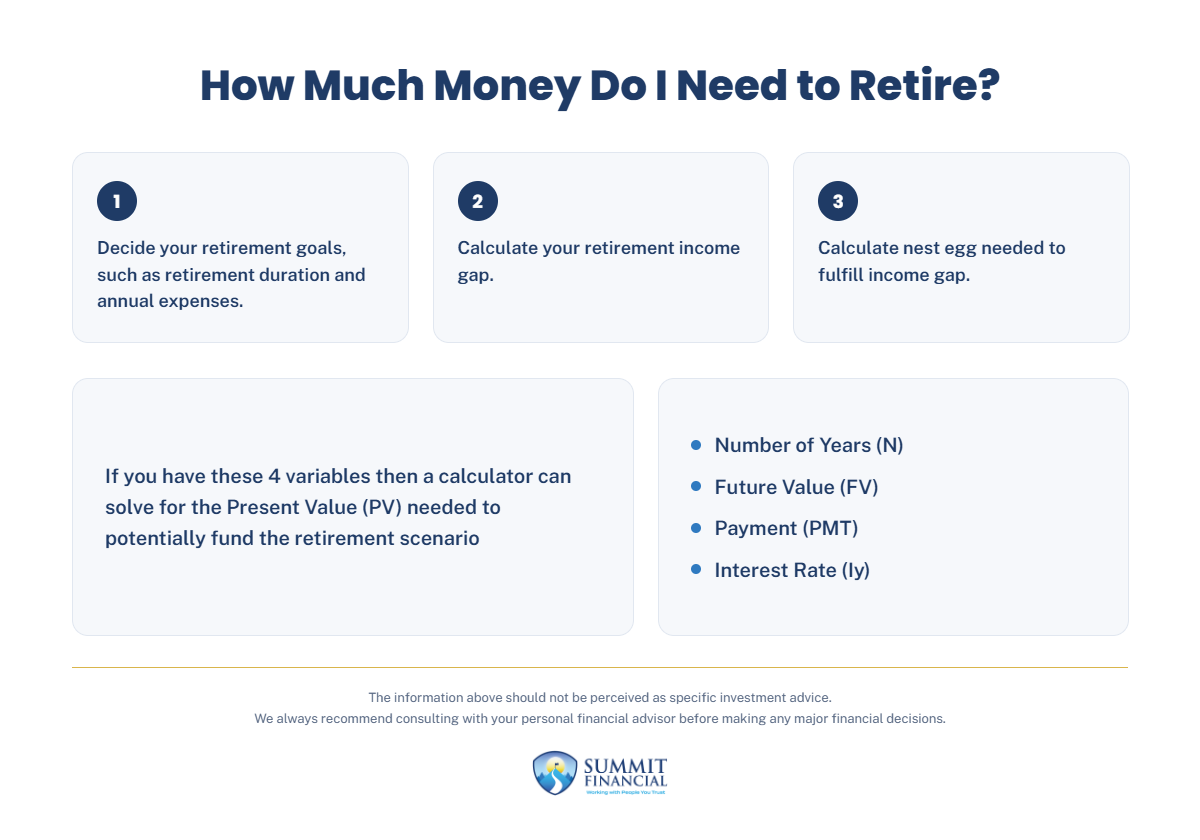
The first step is to decide on your retirement goals. There is an array of factors to consider, but we believe the two most important are the duration of retirement and the client's annual expenses.
If you're just starting to think about this, our guide on when should you start saving for retirement can help you establish a timeline and goals based on your age and situation.
What Is Your Retirement Duration?
Retirement duration is a two-part equation based on someone's preferred retirement age and their estimated life expectancy.
For example, if someone wants to retire at age 65 and they think they will live to age 90 then their retirement duration is 25 years. Life expectancy can be hard to forecast, so we tend to err on the side of caution and prefer to add at least five buffer years.
If the calculated retirement resources are insufficient under the assumptions used, delaying retirement may be one option to consider. Delaying retirement reduces the number of years that are needed to be funded during retirement, but it also provides someone with more years to save and invest to fund their retirement.
What Are Your Average Annual Expenses?
Annual expenses is a broad phrase and will certainly vary from family to family. This would include everything from mortgage payments, household bills, groceries/restaurant spending, vacations or entertainment, gifting, and medical expenses.
We understand that expenses may vary throughout retirement, but for a rough calculation, we are primarily concerned with solving for the average amount of expenses per year.
An average level of expenses would at least provide a starting point for our further calculations, and a more accurate calculation may require an advanced retirement planning tool.
(And we can help calculate this number if you reach out to us!)
How Do You Calculate Your Income Gap?
The next step of the equation is to calculate your retirement income gap. This begins with adding up your retirement income sources such as Social Security, pensions, annuity income benefits, or any part-time employment income.
This income total is then subtracted from your expenses calculated in the previous step to derive the income gap that needs to be funded.
For example, if someone has $50,000 of various income sources and their expenses are estimated to be $90,000 on average, then they have an income gap of $40,000 per year.
How Much Nest Egg Do You Need?
The final step is to calculate the total nest egg that is needed to fulfill the income gap that was solved in step #2.
This part of the equation requires performing a Present Value (PV) calculation. There are calculators that can solve for this either physical or online-based, and excel has this function as well.
You would input the remaining variables, and the calculator would provide an estimated value for the PV needed to fund the income goals for the specified duration.
You can also use our 401(k) calculator to help estimate your retirement savings needs and project your retirement account balance.
What Variables Go Into This Calculation?
The remaining variables are:
Number of Years (N) – This is the duration of your retirement goal. A longer retirement would likely require a larger nest egg to be successful.
Payment (PMT) – This is the annual income amount that is provided by the nest egg. Once again, we would use the average expense amount since this calculation does not allow for varying levels of expenses. (This number is usually expressed as a negative since it is a cash outflow for the calculation.)
Interest Rate (Iy) – This is the annual rate of return of your assets since they would continue to grow over time. We typically would use the average expected rate of return of the investment asset blend, but using a lower than average rate may be a way to calculate a more conservative estimate.
Future Value (FV) – This would likely be $0 to reflect the desire to spend down all of your assets as you pass away. If you wanted to leave a specific inheritance amount, then that (negative) amount can be listed here instead as this amount is the remaining value of your assets at the end of your life.
How Do These Calculations Work in Practice?
Here are a handful hypothetical calculations using different inputs for the variables above. You can see how a tweak in one of the variables impacts the overall Present Value answer.
Increasing the number of years, increasing the payment amount, decreasing the rate of return, or increasing the future value amount would all require a higher present value of assets.
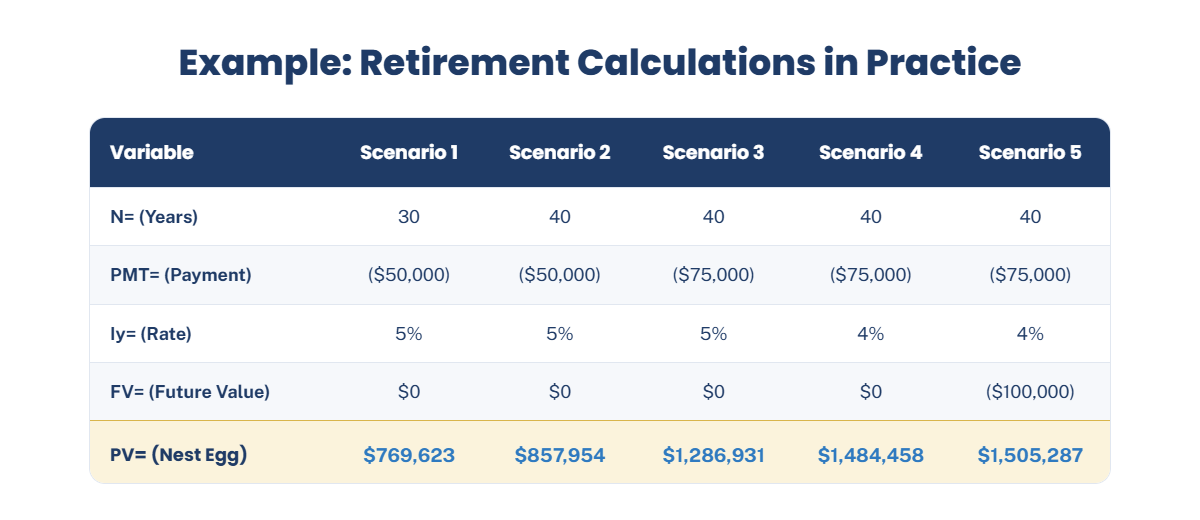
These illustrations are for educational purposes only and the details above are not pertaining to any specific client or situation. For purposes of these examples, the assumed rate of return is applied consistently over the specified period. Actual investment returns fluctuate from year to year, and the sequence of investment returns can affect the amount of assets available to fund retirement withdrawals.
What Are the Limitations of This Basic Approach?
As we mentioned, this is not a perfect calculation to forecast a retirement picture. We much prefer to walk a client through our robust planning system since it includes an actual success rate based on the inputs.
It also allows us to perform stress tests as impacts from inflation, market volatility scenarios, tax adjustments, and allows us to tweak different scenarios quickly to view the overall impact on a client's retirement plan.
Key Takeaways
- Retirement savings needs depend on three critical factors: your retirement duration, annual expenses, and expected investment returns.
- Consider starting by calculating your retirement duration based on your preferred retirement age plus a 5-year safety buffer for longevity.
- Determine your income gap by subtracting guaranteed retirement income (Social Security, pensions) from your total expected expenses.
- Use the Present Value calculation to determine how much nest egg you need to fund your retirement income gap over your desired retirement period.
- Even small adjustments to key variables—years, expenses, or investment returns—can impact your required nest egg size.
- A professional retirement planning system can model scenarios, stress tests, and adjustments more accurately than basic calculations alone.
Questions About Planning Your Retirement?
If you have any questions about retirement, your investment portfolio, retirement planning strategies, tax planning, or anything else in general, please give our office a call at (586) 226-2100.
Please feel free to forward this commentary to a friend, family member, or co-worker. If you have had any changes to your income, job, family, health insurance, risk tolerance, or your overall financial situation, please give us a call so we can discuss it.
We hope you learned something today. If you have any feedback or suggestions, we would love to hear them.
Best Regards,
Zachary A. Bachner, CFP® with contributions from Robert L. Wink, Kenneth R. Wink, James D. Wink, and James C. Baldwin
Additional Disclosures:
The calculations use the assumptions identified in the examples, including the specified retirement period, withdrawal amount, rate of return, and ending account value. The assumed rate of return is applied consistently for purposes of illustrating the mathematical calculation and does not represent an expected or guaranteed rate of return. Actual investment returns fluctuate from year to year and may be substantially higher or lower than the assumed rate. The sequence of investment returns may also affect the amount of assets available to fund retirement withdrawals.
The calculations do not account for all factors that may affect an individual's retirement outcome, including inflation, taxes, investment fees and expenses, changes in spending or withdrawal needs, changes in income, Social Security benefits, longevity, market volatility, investment allocation, or an individual's financial circumstances, objectives, and risk tolerance. Accordingly, the results should not be interpreted as a prediction of the amount an individual will need to retire or the amount an investment portfolio will earn or sustain over a particular period.
Individuals should consider their own financial circumstances and objectives and consult with appropriate financial, tax, and legal professionals before making financial or investment decisions.
decisions.

Zachary A. Bachner, CFP®
Advisor | Director of Financial Planning, Summit Financial Consulting, LLC
After graduating from Central Michigan University in 2017 with specialized degrees in Finance and Personal Financial Planning, Zachary “Zach” Bachner set himself apart by earning the CFP® designation and passing the Series 7, 63, 65 licensing exams early in his career. Zach gained valuable real-world experience with the team at Summit Financial Consulting, who treated him like family. Their guidance helped him refine his skills in practical, client-centered planning, where putting their needs first was non-negotiable. This focus on trust-building not only allowed him to cultivate strong relationships, but also allowed him to continue doing what he loves most: solving client problems through efficient financial planning strategies. Leveraging his experience, Zach now helps others navigate finances through clear, informative writing. His work has been published in major outlets like Yahoo Finance, MarketWatch, and Investment Business Daily, establishing him as a valued resource. By simplifying complex topics, Zach aims to empower everyday people to confidently pursue their financial goals
More about Zachary →